
Okay, Jordan, what’s today’s tip?
Today’s tip is using a track setting guide. And what a track setting guide is, is you set a piece, it’s normally a little piece of metal that’s curved or straight, inside the running rails of your model railway track.
And it’s for flex track. And you run this back and forth and it’ll help you get whatever degree curve that you need set or a straight, if you have the straight ones.
Okay, so why would I want to not just lay my track and just get on with it? Why do I not want to just put it down?
Okay, because have you ever looked at a set of real railway tracks? You’ll always notice that they are very well in a straight line. They’re always not wiggly unless they’re a really bad branch line, at which point, that’s a different story.
But most mainline trackage in the UK and the US are very well maintained straight right -of -ways with very gentle curves. These will help you because unlike laying a piece of track on the phone and working it to how you bend it, these will be right no matter what.
I guess this is going to stop me having any tight spots or any changing, you know, changing radius. So we’re going tight and tight and tighter into the radius and using that as a radius. This will make sure it’s consistent all the way through my curve.
Yes. Apart from where I want to ease it out at the edges. Okay. And so, and this will stop me from going too tight, which will make my trains won’t fall off.
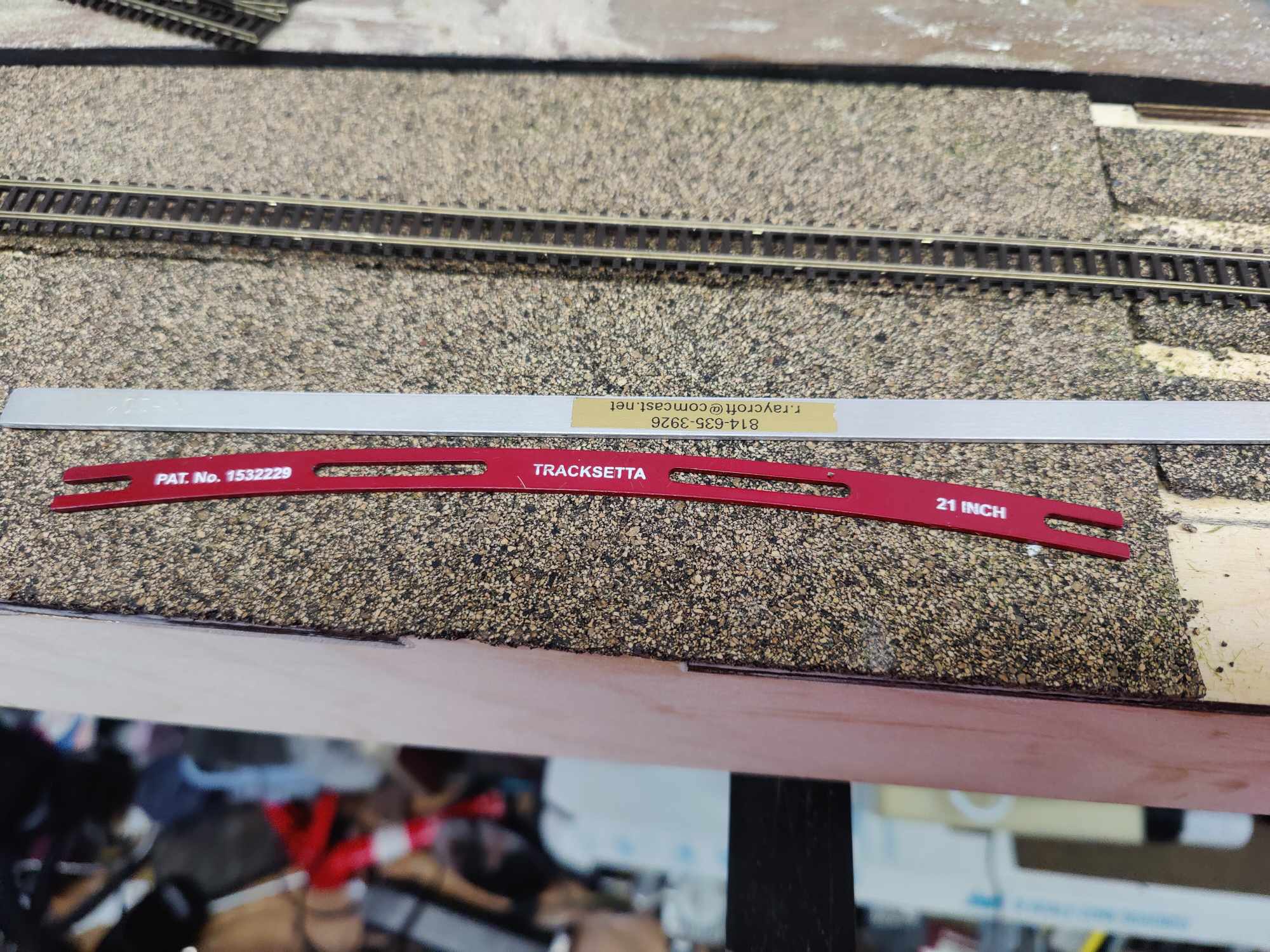
Okay. But I can’t use this on set track because set tracks already to the correct radius or shape. So it’s only for flex track. Okay. And so what kind of and as well with this, I guess, if you were a modular modeler where you’ve got standards to meet some minimum radiuses, this will allow you to make sure all your track is at least bigger than the minimum radius.
That’s very correct. And the other thing is, is when you’re laying your track on, like you said, you’re laying that. Your eye might see it as a very gentle, smooth curve, but there’s going to be where the track shifts a little bit, even if you shift a little bit and basically gets tighter or wider.
I mean, you mean to say that just drawing a line down the bench work with like a pencil and a piece of string doesn’t mean I get a perfect curve?
well.
So I should use the flex track and a track set a guide, then I can make some radius is perfect. So where can, where can people get these from?
So Peco offers them in N Gauge and they are available from Walthers.
Okay, so you walthers dealer should have them.
Yes, however, I believe I have only seen the Peco ones go up to 21 inches. I could be wrong on this. There is another company in the UK. It’s called West Hill Wagon Works. They go up to a 36 inch radius and they do 00/HO, engage and 009 for all those concerned and then TT120.

Okay. And TT 120 is TT gauge, which is 12 mm, 12 mm between the rails and is very, very popular in Europe used to be popular in the US. And he’s also just becoming a new scale in the UK too, with Hornby and Pico.
So that’s really cool. And I also know that there is a, because I actually have some of these things. And I know that there is a company in the US that make track gauges, track guides, sorry. In N scale, you can get them from Rocky Mountain Train Supply in Denver.
And they do like 24 inch long ones. Because I guess the length of them, if you want a straight section, you don’t want a straight section that’s your flex track might be 30 to 36 inches long. You don’t want a 30 inch section of straight.
So these Peco track setters are about six inches, six to eight inches long. Yeah.
That’s what I would say.
Okay, cool. So people can get them from your Walthers dealer from Peco called Tracksetter, or you can go and get them from the UK or the other manufacturers, these kind of things. But our tip for today is make sure you use a track guide when you’re laying your flat track.
 Gordy's | Model Railroads