My main modelling interest is 1950s New England and in O scale, but on a recent visit to Wisconsin I spent a few days photographing along ex MILW and CNW tracks. I was impressed by the variety of motive power and rolling stock that I witnessed and there was hardly a unit train in sight. I decided that maybe it was time to do a bit of HO modelling again, having last modelling in HO as a teenager and attended some Calder Northern meets.
A green light was given by her who must be obeyed and permission was granted to visit a local hobby shop and Walthers show room (well worth a visit if you’re in Milwaukee). I remember fondly as a youngster taking my pocket money along to Calder Northern and coming away with a couple of Athearn blue box kits, which I would have, assembled and running in my little train when the next meet came around. I knew from reading the modelling press that most freight cars now come ready to roll, but I managed to pick up two Accurail kits from Walthers and after a trip to Engine House Services in Green Bay, WI I also acquired some of the new Evans 5100 double door box car kits in WC livery from Scale Trains.
Building the Kit
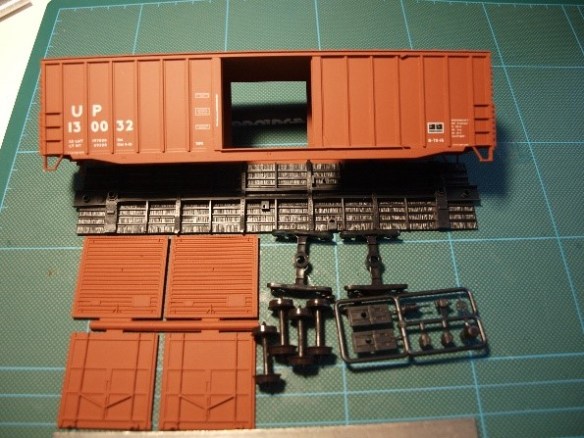
I decided that as they were similar to the Athearn blue box kits I used to build as a youngster I would start with the Accurail kits first. I had two types of 50’ box cars a BAR 50’ Welded Plug Door boxcar and a UP 50’ Exterior post boxcar. Picture 1 shows the parts you get in the kit, it includes Accurail knuckle couplers, correct doors and plastic wheel sets.
I decided to replace the Accurail couplers with Kadee number 5’s, to be consistent with my other stock.
The first thing to do with these kits is to clean up the parts, fortunately the plastic is moulded in the correct colour so a little sanding won’t result in the need for a new paint job. I had to remove flashing from the roof of the boxcar and you also need to remove some material from the underframe (pic 2&3).
Once all the parts are cleaned up the next thing to do is fit the weight to the floor of the box car, fortunately the doors on these boxcars are fixed otherwise this would be rather unsightly. I used vitalbond medium CA to secure the weight to the box car floor, this cures in about 20 seconds (pic 4&5).
There are three detail parts to add to the underframe and these go on next, these represent some of the brake gear, but the underframe is mostly hidden once the body is on. I suppose I could have added more details here and certainly if this was a O scale freight car I would, but expending lots of effort on things that cannot be seen isn’t very efficient modelling in my opinion.
When I was a teenager an old head said to me that in a train of 20 cars if the first three are super detailed and then there is a super detailed car every 6 or 7 cars the viewer will be tricked into thinking they are looking at a rake of 20 super detailed freight cars. In reality they would have seen maybe 5 super detailed cars and 15 straight from the box Ahearn blue box freight cars. Even in O scale my rule is if a part cannot be seen clearly at 2ft when stationary, then it definitely won’t be visible when your train is moving at a scale 20mph.
So back to kit building, I added the three detailing parts using Plastic Magic and a micro brush as an applicator, I find these cheap little brushes much easier to use than a paint brush and they come in a variety of different sizes. A neat feature of the Accurail kit is that the parts are moulded with semi-circular storks to make sure you get the parts fitted the right way round. So after removing them from the sprue with sprue cutters I cleaned them up with a nail file, added a dab of plastic magic to both parts and put them in place with a pair of tweezers.
Despite my comments about detailing, one thing I knew I wanted to add to this kit was air hoses, as I am considering fitting pacific western rail systems magna lock brake lines to my HO modern image stock. So at the least I need somewhere to attach them to, as the Accurail kits do not include any air hoses. I chose to fit Kadee part 438 which includes the air hose and angle cock and each packet contains ten pairs.
Each air hose and angle cock comes in three very small parts, two parts make up the mounting bracket and the third is the hose. To fit the mounting bracket to the underframe I needed to remove some of the bracing next to the draft box. I was then able to attach the mounting bracket to the side of the draft box using some more plastic magic.
I haven’t attached the air hoses yet as they are likely to get knocked off, so I will install them once the trucks and couplings have been fitted. As the underframe was now ready for fitting couplings and trucks and these are going to get some paint before fitting I decided to move onto the body. The kit comes with plug and Youngstown doors but for the prototype Youngstown doors needed to be fitted, I carefully cut the doors from the sprue with a No5 blade. The doors can only be fitted in the closed position and again these just need a spot of plastic magic to fix in place.
Paint & Weathering
So now with the body and underframe ready for assembly I decided to start the painting and weathering. On my trip to Wisconsin fewer freight cars hadn’t been tagged by the local artist than those that had so I needed to add Graffiti to my two freight cars. I used microscale decals 87-1364 Modern Era Graffiti which I cut out and applied to the box cars, what I soon realised was that fitting large decals to exterior posts wasn’t easy in fact its nigh on impossible, but the welded BAR box car took the decals much better. I used Vallejo decal fix after applying the decals to the box cars and the picture show the box cars with the decal fix still curing.
Rust Spots older equipment especially these nearly 40 year old Box cars seem to be prone to rust appearing on the cars, usually in patches where there has been damage, around doors etc. So to model these I am using a two stage process with oil paints, first I used a cocktail stick to apply small rust spots with burnt sienna paint.
After leaving these for two hours to dry I ran a brush lightly soaked in turps down the side of the cars to give a streaked look.
For the BAR box car the older of the two freight cars I wanted to go for a general overall rust and grime look. I started by adding small quantities of burnt umber to the top of the sides of the boxcar, I then streaked this down the side of the box car using a wide brush dipped in white spirits.
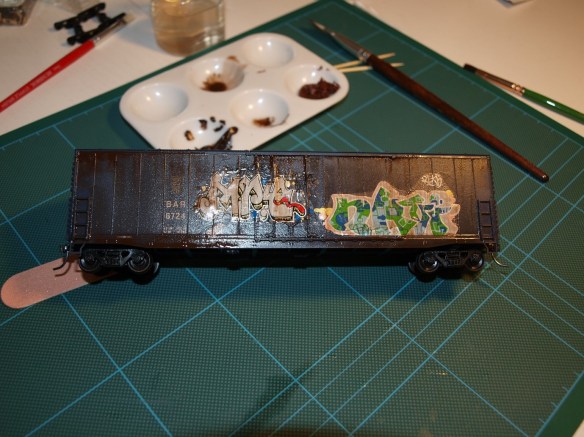
For the roof I added raw sienna down the centre, as this is a pitched roof I then drew my white spirit soaked brush down both sides of the roof going from the centre to the outside.
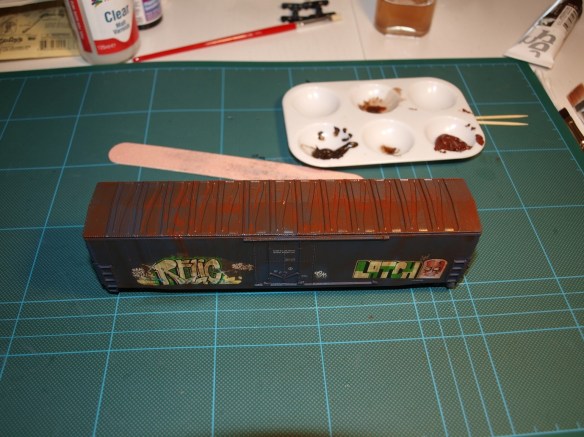
I then drew a few streaks down the box car sides to give the look of rain washing the rust from the roof down the car sides.
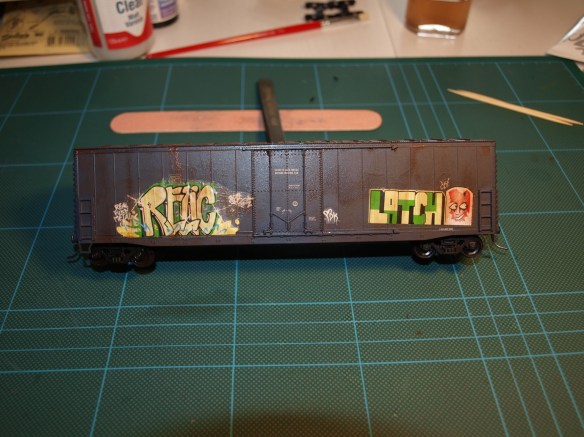









 Gordy's | Model Railroads