
Following on from my Layout Inspiration post here is part two of that post – Layout Planning, I will start with the must haves and nice to haves before looking at operations and portability.
So the must haves and nice to haves
Must haves
- 18sqft of scenery so sceniced staging a must
- Space 6ft x 3ft x 2 ft (to fit in the trunk/boot of my car)
- N Scale
- at least 25ft of track
- Meet the requirements of the NMRA Civil section 2
- Prototype Ackerville must be represented on part of the layout
Nice to haves
- some switching
- continous operationg for train shows
- a self contained lighting rig
- depth of frame for folding legs with castors
- DCC operation
- variation in scenery for max AP points
- a town scene
- the ability to have prototypical operations
Here is attempt one at a track plan, I have chosen to compress Ackerville onto one side of the layout and add a small town onto the other side of the layout. This means that I can choose to operate one side or the other at train shows/at home making the layout two scenes for railway/railroad shows. Castors would allow the layout to be moved to the centre of the room for full operating sessions.
At the top of the plan we have a small town and at the bottom on the other side of a backscene divider you will see Ackerville.

Operating
Every layout needs a reason to exist or else it is just trains passing through nice scenery which is not the objective I am looking for. So to help understand how the layout works lets see the two railroads trackage rights, in the track plan below CN is in Blue and WSOR is in Red.
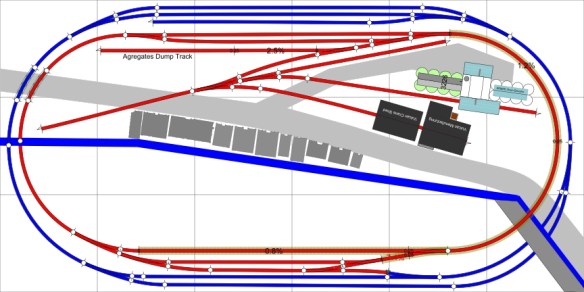
The layout can accomodate upto 5 trains, which would be 2 CN through frights and a CN local with the WSOR handling 2 locals. Every Model Railroad needs a reason to exisit even a small one such as this so lets explore the scheme. At its heart of this railroad the Class 1 mainline in the example the CN brings cars to interchange with the short line (WSOR) who then pick up and exchange cars before taking the goods into town and switching the local industries they then return to the interchange and exchange cars with the class one road.
The great thing about this railroad though is that you can choose to operate it in such a manner and probably occupy upto three crews for a 1-1.5 hour operating session, you can also do some switching and leave a train running on the mainline when operating the layout at home or exhibitions.
Portability
Being only 3ft x 6ft and 2ft tall this layout will be dificult to move but will fit through a 30″ door way. The framing can be made deep enough to accomodate folding legs with castors making transport so much easier. the layout will have a centre backscene which should allow for a lightweight lighting frame to be supported from it that will illuminate the layout at Model Railroad shows. This doesn’t need to extend to the edge of the baseboard and could just be some spot lamps fitted to a removeable upright that slots into the backscene. This should allow the layout to be set up and taken down at train shows very quickly which is an essential requirement as no one wants to spend hours at the end of a long weekend stripping down a layout.
Notes
The plan is drawn on Anyrail software, the track used is Peco Code 55. The track will disappear into the backscene on the left hand side through forest and on the right hand side under overpasses.
 Gordy's | Model Railroads
Great article! It really explains your thought process as you work out how to turn these restrictions into a functional and fun layout.
LikeLike